Misool is remote. That is the whole appeal, and it is also the only real safety question. Treat the islands as having no hospital-level care and no recompression chamber. Everything that keeps you comfortable and safe there arrives with you on the yacht. So the answer depends on three things: when you cross, what the vessel carries, and how the crew runs the diving. This guide takes each in turn, with the numbers we actually plan around.
Sea state: the Sorong–Misool crossing and seasonal swell
Start with the crossing, because it is the part most guests worry about. Misool lies roughly 90–110 nautical miles south of Sorong, which means 9–14 hours underway at 8–10 knots. Yachts we place normally treat it as an overnight passage of 10–14 hours. Guests board in the late afternoon, dine, sleep, and wake at anchor among the karst islands. The route crosses open water, so timing matters more than the size of the yacht.
From October through April the sea is generally cooperative. November to March is the most reliable window, and January and February usually bring the calmest crossings, with visibility of 25–35 m on the better days. The south-east monsoon runs May to September. June to September is the roughest stretch, July and August in particular, and exposed water south of Misool can become difficult or unsafe. Several operators do not run Misool at all in those months, and we do not sell it as a reliable window.
October and April are transitional. October usually marks improving conditions. Late April can see the south-east swell arriving early, so a late-April charter should carry a flexible plan that keeps the yacht in sheltered anchorages if the forecast turns. The captain’s call is final. A good captain will hold a departure by a night rather than push a tired guest list across a confused sea, and that call should not be argued with.
| Months | Sea state around Misool | What we advise |
|---|---|---|
| October | Transitional, usually improving | Cross with confidence, keep one flexible day in the plan |
| November–March | Most reliable; January–February calmest, visibility 25–35 m | Book the overnight crossing; the prime window for first-time visitors and families |
| April | Transitional; late April can deteriorate | Depart early in the month; accept that the captain may hold or reroute |
| May–September | South-east monsoon; June–September roughest, July–August worst; visibility can fall to 10–15 m | Not sold as a reliable window; operator-dependent and unverified |
For the full month-by-month picture, including manta timing, read when to charter a yacht to Misool.
Vessel safety: certification, tenders, oxygen, satellite comms, crew ratio
What makes a yacht safe in Misool is not the joinery. It is paperwork and equipment, and a crew that uses both without being asked. Before we place a guest on any vessel we confirm the list below in writing, and you are entitled to ask for the same. The same checks are part of how the Charter Desk works on every yacht we place.
- Valid Indonesian ship’s certificates and a current safety inspection, which the captain can show on request.
- Emergency oxygen on board, with a crew member trained to administer it, plus a dive first-aid kit and a named first responder among the crew.
- Satellite communications, whether a satellite phone or a data terminal, because mobile signal is unreliable or absent for most of the route.
- Tenders with reliable engines and radios. Most dives, snorkels and lagoon visits happen from a tender, so the tender is the vessel you will spend much of the day in.
- A dive deck run by certified guides, with the guide-to-diver ratio stated in writing. One guide per small group is the sensible norm, and no guide should be looking after a full boatload alone.
- Life rafts, lifejackets for every berth, children’s sizes if children are aboard, and a safety briefing on the first evening before the crossing begins.
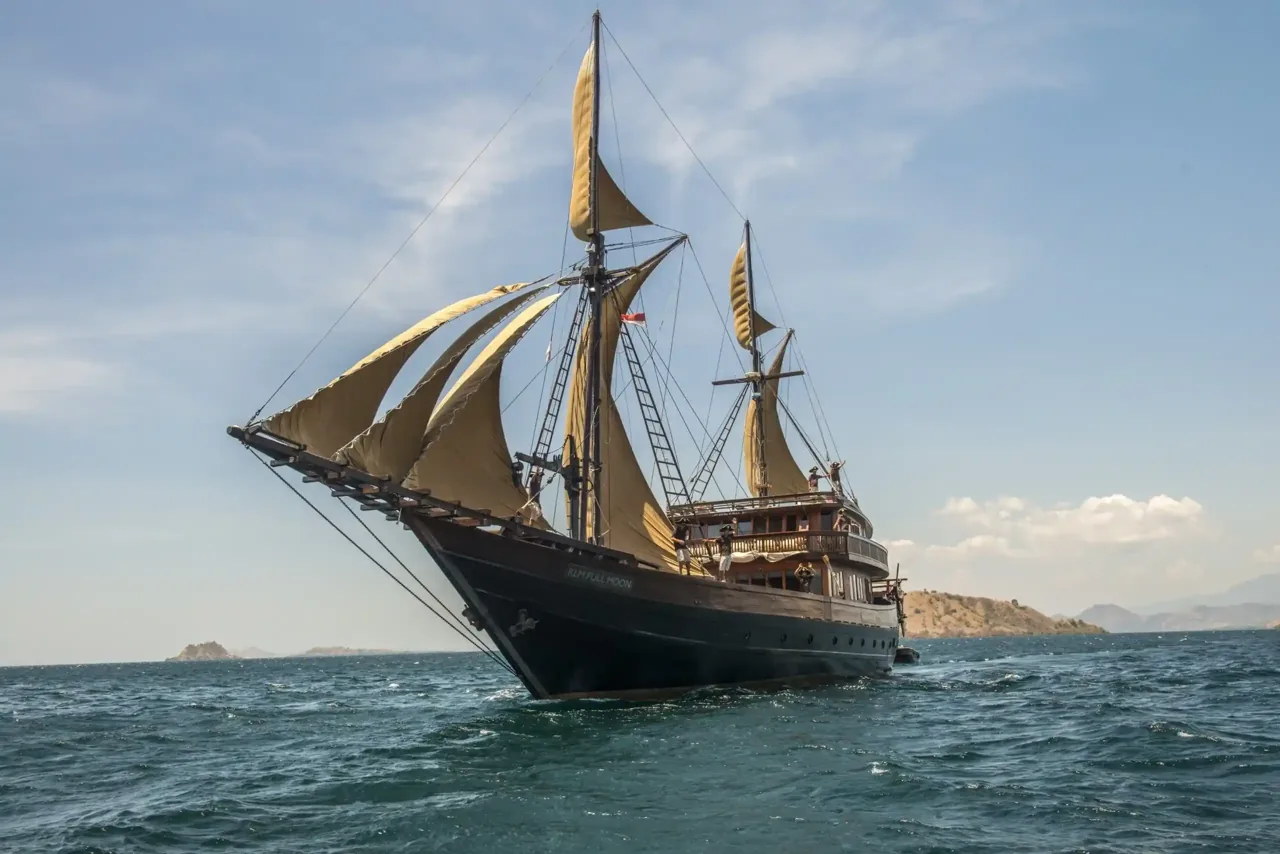
Crew ratio matters more than it sounds. A phinisi carrying 18 guests sails with a captain, engineers, deckhands, chefs, stewards and dive guides, and that number should sit comfortably above what the guest list needs. Ask for the crew list. Two yachts in our Misool portfolio, Sanctuary at 48 m and Lasha at 52.5 m, are phinisi liveaboards, and we confirm their equipment lists before any charter is signed. You can compare the classes on our phinisi charters of 35 to 50 m and superyacht charters above 50 m pages.
One more point. The Misool Marine Reserve requires boats to use designated mooring buoys rather than anchor on reefs, and it prohibits jet skis and other motorized water toys inside the reserve. A yacht that follows these rules is also a yacht that takes its own safety seriously. The reserve is patrolled by the Misool Ranger Patrol, a local unit of roughly 18 rangers working from three stations with five patrol boats, so you are not alone out there. Details are in our guide to the Misool Marine Reserve.
Health: malaria precautions, vaccinations, hyperbaric access and evacuation realities
Misool sits in Southwest Papua, which travel-medicine clinics treat as a malaria-risk area. See a travel-medicine clinic well before departure and discuss prophylaxis. Most of a charter is spent at sea, where mosquito exposure is lower, but the night in a hotel in Sorong before departure and any shore visits to villages or viewpoints do count. Bring repellent, wear long sleeves at dusk on deck, and sleep in your air-conditioned cabin with the door closed.
On vaccinations, keep your routine ones current and let the clinic make the Indonesia-specific calls. They will usually raise hepatitis A, typhoid and a tetanus booster. The decision is theirs, not ours, and we do not give medical advice. Bring prescription medication in hand luggage with a copy of the prescription, plus a spare supply in case the return is delayed by weather.
Now the part that should be said plainly. There is no hyperbaric chamber in Misool itself. Reaching recompression treatment means at least the overnight passage back to Sorong, 10–14 hours, and possibly a domestic flight onward from Sorong’s Domine Eduard Osok Airport (SOQ): Makassar is about 3 hours 20 minutes, Manado about 2 hours 20 minutes, Jakarta 6–8 hours, and Bali about 4 hours once Garuda resumes the route on 25 October 2026. That is the evacuation reality, and it is the reason the diving rules below are conservative. Ask any operator to name the chamber it would use and how the transfer would run. A vague answer is a reason to choose a different yacht. Our getting to Misool guide covers the flight options in full.
For minor illness and injury, the yacht relies on crew first aid, a well-stocked medical kit, and satellite communications to a doctor on shore. Tell us about any condition, allergy or mobility limit at booking. It goes to the captain and the chef, and nobody else.
Diving rules: no-deco, 30 m max and fly-after-dive windows
Misool’s sites range from Daram’s shallow coral gardens at 3–18 m to Magic Mountain, an exposed seamount at 7–40 m. Boo Windows sits at 5–30 m, Fiabacet at 8–35 m, and Nudi Rock, the relaxed macro site, at 5–20 m. Currents at the exposed pinnacles run moderate to strong and change with the tide. These are not difficult sites in the right conditions, but the margin for error is thinner than it is near a city with a chamber.
The rules our guides apply are simple. Every dive stays within no-decompression limits. Maximum depth is 30 m regardless of certification, which still covers the best of every site listed above. Current-prone sites such as Magic Mountain and Four Kings are dived near slack tide and are for advanced divers only. Each buddy pair carries a surface marker buoy, and a tender follows the bubbles for the entire dive. Snorkelers and less experienced divers are steered to Daram and Nudi Rock, where conditions are calmer. Site by site detail is in our Misool dive sites guide.
Flying after diving is the one rule guests most often forget. Follow DAN guidance: wait at least 18 hours after multiple days of diving before a flight, and 24 hours to be conservative. On a Misool charter the last dive is the afternoon before the overnight passage back. The crossing takes 10–14 hours and most flights out of Sorong leave later the next day, so the window is usually met without extra planning. If you have booked an early flight, tell us, and the final day becomes a snorkeling and lagoon day instead. Water sits at 27–30°C, so a thin wetsuit is enough; our packing guide has the rest.
Insurance that covers remote Papua; solo travelers, children and elderly guests
What travel insurance do you need for Misool? A policy that does four things. It must cover medical evacuation by sea and air from remote Indonesia, not just treatment once you reach a hospital. It must cover scuba diving to the depth you plan to dive, with hyperbaric treatment included. It must cover trip cancellation and interruption with a weather clause, because the captain may hold a crossing. And it must state those things in writing, because many credit-card policies exclude diving or cap evacuation at a figure that would not get you from Misool to Makassar. A separate dive-accident membership such as DAN is a sensible supplement. Carry the policy number and the assistance line on paper, not only on a phone that will have no signal.
Read the charter contract with the same care. Deposits and cancellation terms are set out in our booking process page, and the weather clause in your insurance should match them.
Solo travelers are well served by a shared-cabin liveaboard, where a buddy is assigned and the group dives together; see our luxury liveaboard options. Families are better served by a private charter, because the yacht moves at the family’s pace, the tender waits for the slowest swimmer, and the itinerary can stay in sheltered water with shallow sites like Daram. Children’s lifejackets, a shaded deck and a chef who will cook plain food are the practical requests, and we make them before you ask. Elderly guests should think about one thing above all: tender boarding. Ask about the swim platform, the ladder and whether a crew hand is always at the step. On the right yacht it is, and the rest of the trip is no more demanding than a calm week at sea.
So, is Misool safe for luxury travelers? The short verdict
Yes, with three conditions that are entirely in your control. Cross between October and April, and prefer November to March. Sail only on a yacht that shows you its certificates, oxygen, satellite communications and tender arrangements in writing. Dive within no-decompression limits to 30 m, and leave at least 18 hours between your last dive and your flight. Do those three things and Misool is no more demanding than any other remote cruising ground, with a crew whose whole job is to remove the friction for you.
Plan it
If you are traveling with children, parents or a mixed-ability group, the safest Misool trip is a private charter in the November to March window on a yacht whose safety list you have seen. Our Misool family yacht charter page sets out how we build that week: a late-afternoon boarding in Sorong, the overnight crossing while everyone sleeps, sheltered anchorages, shallow snorkeling at Daram and the lagoons, and dive days for the certified members of the party. Sanctuary is one yacht we recommend for it. Seven nights comes to USD 115,500 per yacht before VAT, or about USD 917 per person per night when 18 guests share it.
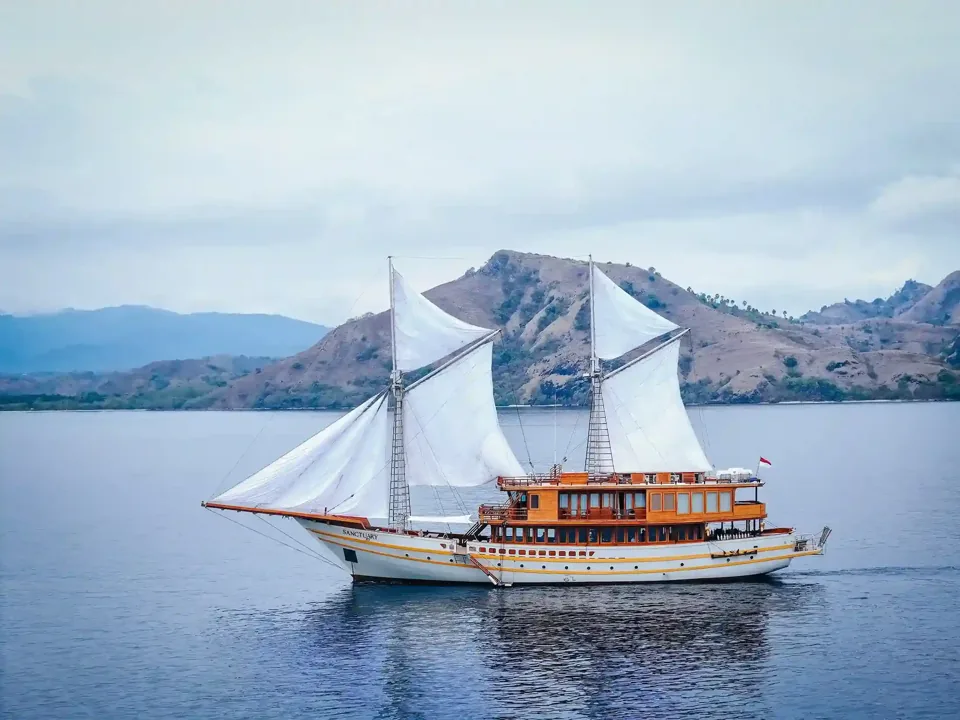
Sanctuary
48 m phinisi · 9 cabins · 18 guests
From USD 16,500 per yacht, per night (+ 11% VAT), 7-night minimum.
How rough are the seas around Misool?
Calm to moderate from October through April, with November to March the most reliable and January–February the calmest. The Sorong–Misool crossing is 90–110 nautical miles of open water and takes 10–14 hours overnight. From May to September the south-east monsoon brings rough, unreliable conditions, worst in July and August, and we do not sell Misool as a dependable window then.
What vaccinations and health preparations are needed for Misool?
Keep routine vaccinations current and see a travel-medicine clinic well before departure. Misool is in a malaria region, so discuss prophylaxis, and expect the clinic to raise hepatitis A, typhoid and a tetanus booster. Pack repellent, prescription medication with copies, and a spare supply in case weather delays the return. We do not give medical advice; your clinic decides.
What travel insurance do I need for Misool?
A policy that explicitly covers medical evacuation by sea and air from remote Indonesia, scuba diving to the depth you plan, hyperbaric treatment, and trip cancellation or interruption with a weather clause. Many card-linked policies exclude diving or cap evacuation too low. A dive-accident membership such as DAN is a useful supplement. Carry the policy number and assistance line on paper.
Can I fly home immediately after diving in Misool?
No. Follow DAN guidance and allow at least 18 hours after several days of diving, ideally 24, before boarding a flight. On a Misool charter the last dive is the afternoon before the overnight crossing back to Sorong, which takes 10–14 hours, so by the time you reach a morning or afternoon flight the window is usually met. Tell us if you hold an early flight.
What rules are covered in a Raja Ampat dive briefing?
Depth limit of 30 m, no-decompression diving only, slack-tide timing at current-prone sites, buddy pairs with a surface marker buoy, tender pick-up procedure, and reserve rules: no touching or collecting marine life, no fishing, mooring buoys instead of anchoring on reefs, and no jet skis. Advanced-only sites such as Magic Mountain and Four Kings are named in the briefing.
What are the Indonesia liveaboard safety rules for 2026?
There is no single guest-facing rulebook to download. In practice, safety rests on the vessel’s Indonesian certificates and inspection, the equipment it carries (oxygen, satellite comms, tenders, life rafts), the dive-operation rules its guides apply, and the Misool Marine Reserve’s conduct rules enforced by the ranger patrol. Ask for all four in writing before you commit to any yacht.
Tell us your dates and who is traveling, and we will confirm the sea-state window and the yacht’s safety equipment list before you commit to anything. WhatsApp +62 811-3941-4563 · [email protected]