When is manta season in Misool and Raja Ampat
Manta rays are present in Misool year-round, and a diver can meet one in any month. What changes through the year is how predictably they gather at the cleaning stations, and that is what a season means here. The strongest cleaning-station period is generally December through March, with January and February the most consistent choice, and some operators extend the peak into early April.
That window sits inside the wider Misool yacht season of October through April. November to March brings the most reliable conditions overall, with water around 28–30°C and visibility frequently 25–35 m. The south-east monsoon typically runs May through September, roughest in June to September and especially July and August, when the exposed crossings south of Misool can become difficult. Mantas may still be there, but the sea does not reliably let you reach them.
For a trip built around manta rays, the practical answer to the best month to see mantas in Misool is January or February, with December and March close behind. Our guide to the best time for a Misool luxury trip covers the whole calendar, including the shoulder months.
Magic Mountain explained: how deep it is and why mantas come
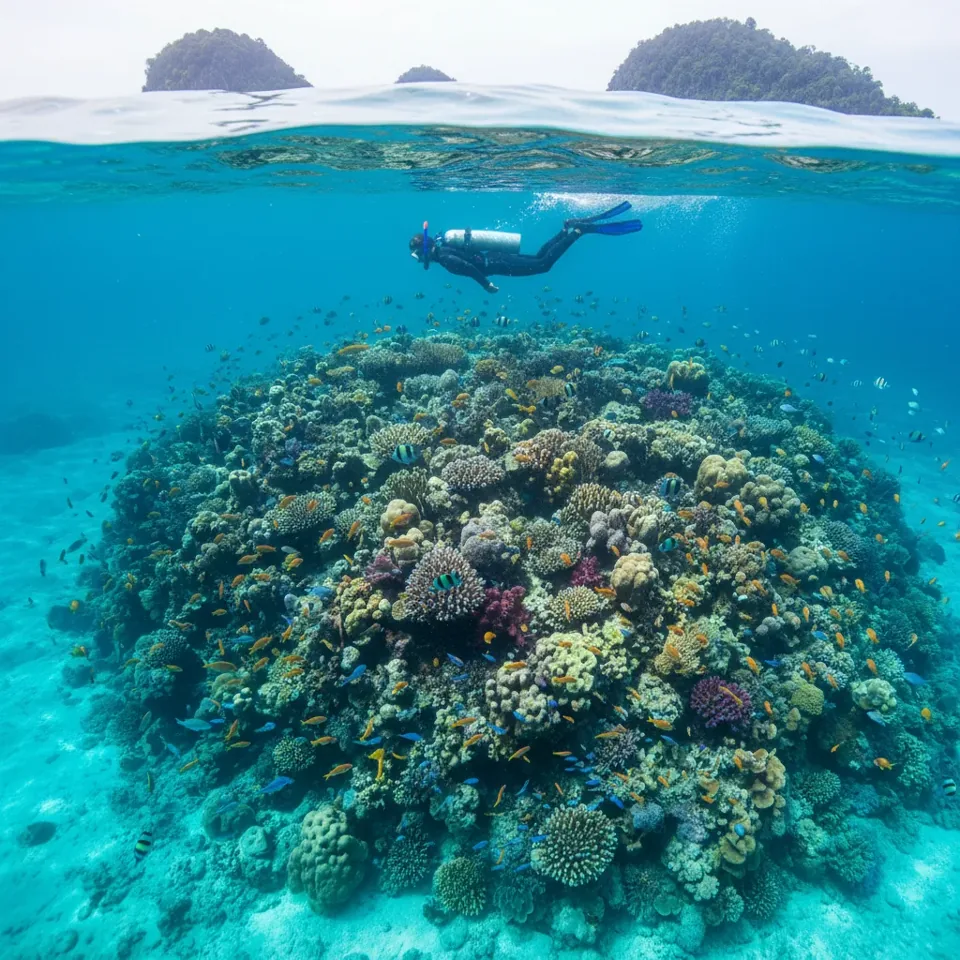
Magic Mountain is a submerged pinnacle in southern Misool. Its top sits at roughly 7–8 m and the structure drops to about 40 m, which is why the question of how deep Magic Mountain is in Misool has two answers: shallow enough that the cleaning station is within reach of a careful snorkeler on a calm day, deep enough that the dive itself goes well below the shallow plateau. The seamount is exposed to open water, and that exposure is the point.
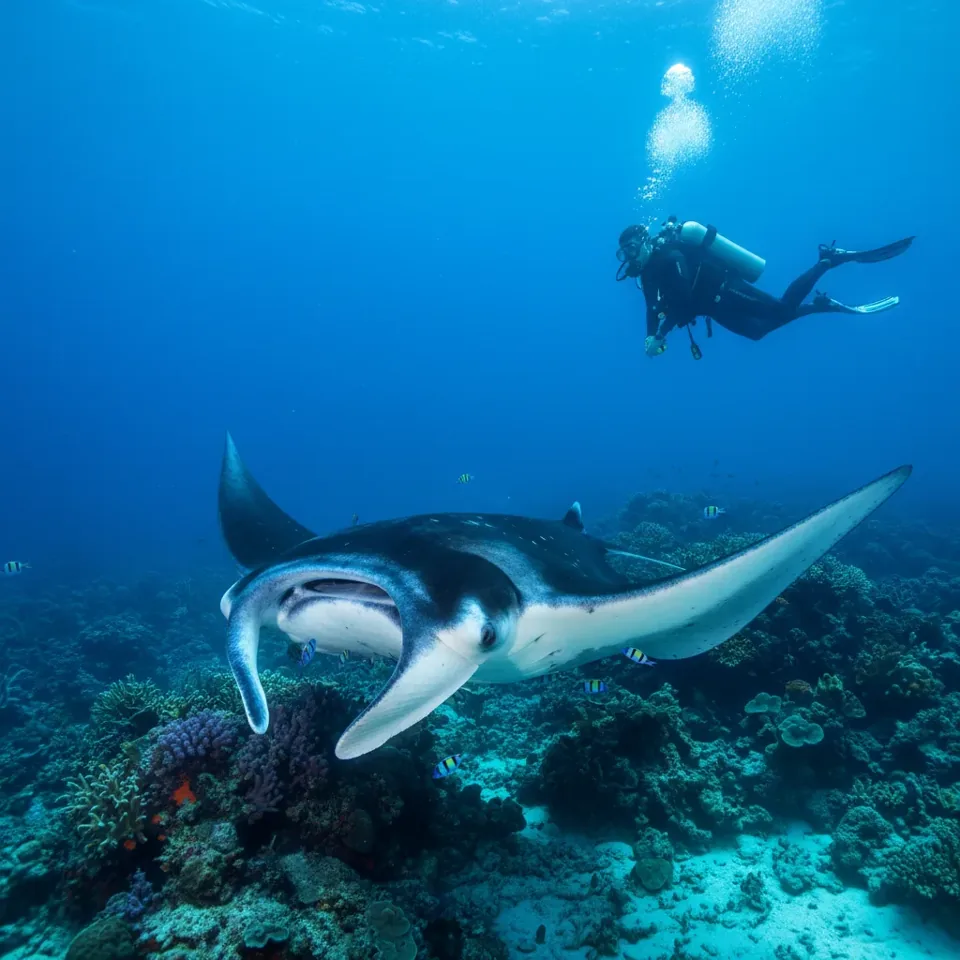
Cleaning stations are patches of reef where small wrasse and butterflyfish remove parasites from larger animals. Mantas queue above them, circling slowly with their cephalic fins unfurled while the cleaners work. On Magic Mountain divers settle low on the reef near a station and let the animals come to them. Reef sharks, trevally and dense soft coral fill the rest of the dive when the mantas are elsewhere.
The site lies inside the Misool Marine Reserve and is reached by vessel. You arrive on a yacht, you dive from its tender and you leave on the same yacht. Our overview of Misool dive sites places Magic Mountain beside Boo Windows, Fiabacet and Four Kings so you can see how one day fits with the next.
Reef mantas, oceanic mantas and Shadow Reef
Both species use Magic Mountain, which is unusual. Reef mantas are the regulars, smaller and seen at the stations through the season. Oceanic mantas are the larger, more pelagic animals that normally live away from reefs and appear at the pinnacle less predictably. Seeing Misool oceanic manta rays is never a scheduled event, but Magic Mountain is one of the Raja Ampat sites where both species are recorded.
The names around the site cause confusion. Shadow Reef, or Karang Bayangan, is commonly used for the same seamount as Magic Mountain, and many site lists treat the two as one. Treat any itinerary that lists both as a single stop, and ask your cruise director which part of the pinnacle they intend to dive. Nearby pinnacles such as Four Kings and Wayilbatan carry pelagic traffic too, and a manta passing in the blue is possible on either.
Whichever species arrives, a diver who stays low and still is tolerated longer than one who moves. Neither species should be chased, touched or blocked from the station, and the guides on the vessels we charter enforce that.
Diving Magic Mountain: profile, current and who should dive it
The dive is an entry from the tender, then a controlled descent to the cleaning-station depth where the group settles and waits. Current is typically moderate to strong and changes direction with the tide, which is what brings the plankton and the mantas. Guides read the tide before the briefing and pick the lee side of the pinnacle to hold station.
Is Magic Mountain suitable for advanced divers only? In practice, yes. The combination of depth to 40 m, open-water exposure, variable current and the need to hold position without touching coral makes it an Advanced Open Water site with recent dive experience and good buoyancy. A reef hook is useful, and a surface marker buoy is standard practice. Nitrox lengthens the time at the station on a 7–40 m profile.
Timing matters more than most sites. Slack or gently running tide is the easiest window, but guides report mantas arriving as the current picks up, so the cruise director will often plan one dive at the quieter end of the tide and one when the flow is stronger. On a private charter that sequence is yours to set, which is one reason divers come to Misool by yacht rather than by cabin. Our Misool luxury diving page sets out how a dive-led charter is run day to day.
The snorkel alternative for non-divers
With the plateau at 7–8 m, Magic Mountain can be snorkeled when the sea is flat and the current light, and reef mantas circling the shallow stations are visible from the surface. It is a decision the cruise director makes on the day, not a listed activity, because the same current that makes the dive productive makes a surface swim hard work. Snorkelers stay with a guide, float above the station and do not free-dive down onto the animals.
For a family with mixed interests, Misool has gentler water that pairs well with a manta morning. Daram, at 3–18 m, is a shallow hard-coral garden with turtles, and Nudi Rock, at 5–20 m, is a calm macro site that works as a snorkel. Both are protected and usable on a day when the pinnacles are running. See Misool snorkeling for how a non-diving guest spends a week here without feeling parked on the sundeck.
Best month to see mantas in Misool: month by month
The table reads the manta season against sea conditions, which is the only honest way to plan. A strong manta month with a difficult crossing is not a strong month for a yacht. Figures are typical ranges and vary by season and operator.
| Month | Cleaning-station reliability | Sea and visibility | Desk note |
|---|---|---|---|
| October | Possible; mantas present year-round | Transitional, conditions improving | Shoulder month, keep the route flexible |
| November | Building | Reliable season begins, 25–35 m visibility | Good run of calm days for lagoons and reefs |
| December | Strong | Calm, 28–30°C water | Peak period opens; festive dates fill first |
| January | Strongest | Calm crossings, best all-around month | Most requested month for manta charters |
| February | Strongest | Calm, 25–35 m visibility | Equal to January for mantas |
| March | Strong | Still reliable | Good month at the end of the reliable window |
| April | Tapering; early-April sightings common | Late April can turn as the monsoon starts | Book the first half of the month |
| May to September | Mantas present, access unreliable | Rough crossings, visibility can fall to 10–15 m | Operator-dependent; the desk does not plan Misool charters here |
Combining mantas with lagoons on a 7-night route
Misool is a 90–110 nautical mile, 10–14 hour overnight passage south of Sorong, so a 7-night private charter spends roughly five full days in the islands with a night underway at each end. Most guests sleep in a hotel in Sorong the night before departure and board after breakfast. The desk handles the Raja Ampat entry fees and permits in advance; the detail is in Misool and Raja Ampat permit fees.
A manta-led week does not need to be a dive-only week. Magic Mountain and Four Kings sit on the same southern circuit as the Fiabacet and Boo reefs, and the lagoons of Balbulol, Wayil and Yapap are reached by tender from anchorages nearby. A typical sequence is a dawn dive at the cleaning station, a second pinnacle dive before lunch, then an afternoon in a lagoon, at Lenmakana jellyfish lake or on the hike to the Harfat Jaya viewpoint. Our Misool lagoons guide lists each stop and how the yacht positions for it.
Because the vessel is private, the cruise director can return to Magic Mountain on a second morning if the first delivered reef mantas and the tide looks better for oceanics. A shared cabin cruise cannot do that. That flexibility is the difference between seeing mantas and seeing the mantas you came for. Serious divers who want Magic Mountain and the Banda Sea in one trip should read about the 12 to 14 night Misool expedition route.
Photography at the cleaning station
Mantas are large, slow and backlit against the surface, which makes them forgiving subjects if you stay still. Use a wide lens, shoot upward with the sun behind the animal for a silhouette or with the sun behind you for the white belly markings that identify individuals. Strobes should be angled out and down to avoid lighting the particulate that comes with the current. Keep the camera below your eyeline and let the manta fill the frame on its own pass.
The ethic matters as much as the settings. No flash bursts in the animal’s face, no approach from above, no blocking the station. The guides will end a dive that disturbs the queue. Our Misool underwater photography article covers rigs, camera rooms on board and which sites suit macro on the days the pinnacles are too strong.
Plan it
A manta charter is a January or February week on a dive-built yacht with a cruise director who knows the tide at Magic Mountain, nitrox on board and a tender that can hold position over an exposed pinnacle. Private Misool charters are priced per yacht, per night from USD 6,400, with a 7-night minimum from Sorong and an October–April season; seven nights on a ten-guest phinisi at the entry rate is USD 44,800 for the whole yacht, about USD 640 per guest, per night. Start with our Misool luxury diving page, or compare whole-yacht and cabin options on Misool luxury liveaboard.
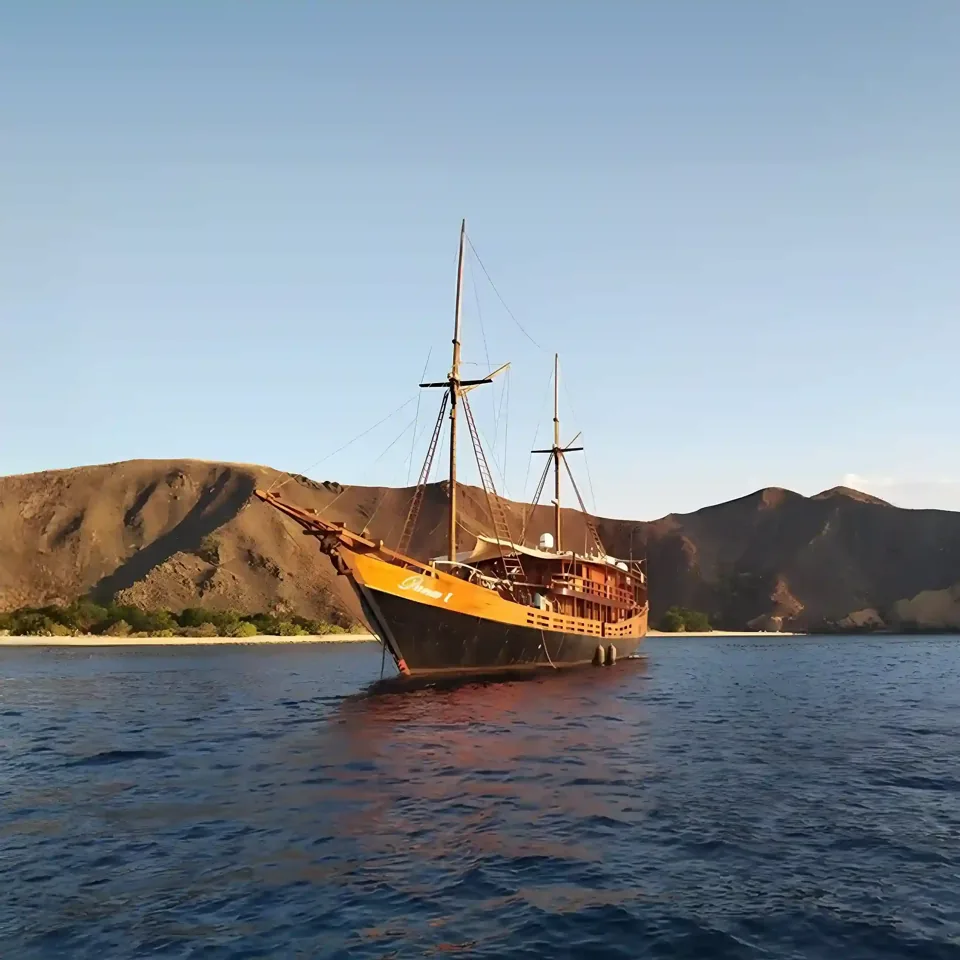
Damai 2
43 m traditional phinisi, 7 cabins, 12 guests. A dive-led vessel with a full dive deck, camera room and nitrox, run by a crew that plans Magic Mountain around the tide rather than the clock. From USD 6,850 per yacht, per night (+ 11% VAT), 7-night minimum from Sorong. Phinisi charter tier, 35–50 m.
Misool manta season: questions we are asked
When is manta season in Misool and Raja Ampat?
Mantas are present year-round, but cleaning-station aggregations in Misool are most reliable from December through March, with January and February the strongest months and sightings often continuing into early April. This sits inside the October–April yacht season, when crossings are calm and visibility runs 25–35 m. From May to September the south-east monsoon makes access to the southern sites unreliable.
How deep is Magic Mountain in Misool?
The pinnacle tops out at about 7–8 m and drops to roughly 40 m. Divers wait near the cleaning stations, while the full profile reaches the deeper slopes where sharks and trevally patrol. Depth, exposure and current together make it an advanced site.
Is Magic Mountain suitable for advanced divers only?
Yes in practice. Current is typically moderate to strong and changes with the tide, the site is open to the sea and holding position near a cleaning station without touching coral needs good buoyancy. An Advanced Open Water certification with recent experience is the usual requirement, and guides will move a less experienced diver to Nudi Rock or Daram instead.
Can you see reef and oceanic manta rays in Misool?
Both. Reef mantas are the regular visitors to the Magic Mountain cleaning stations through the season. Oceanic mantas, larger and more pelagic, appear less predictably and usually from the open-water side of the pinnacle. Magic Mountain is one of the few sites in Raja Ampat where the two species are seen at the same station, which is why it anchors a manta charter.
Can guests snorkel with manta rays at Misool cleaning stations?
Sometimes. With the plateau at 7–8 m, reef mantas circling the shallow stations are visible from the surface on a flat day with light current, and the cruise director decides on the morning whether to put snorkelers in. It is a guided, surface-only swim, never a free-dive onto the animals. On stronger days, non-divers snorkel Daram or Nudi Rock instead.
Can I visit Magic Mountain on a luxury liveaboard?
Yes, and only by vessel. There is no land base, so every visit comes from a yacht or liveaboard anchored in the Misool group. A private charter lets the cruise director time dives to the tide and return on a second morning; a shared cabin cruise follows a fixed route. Both run from Sorong in the October–April season with a 7-night minimum for private charters.
Tell the desk your preferred weeks between December and March and we will reply with the vessels available for a manta-led Misool charter. WhatsApp +62 811-3941-4563 or [email protected].